


https://stanmed.stanford.edu/innovations-help-chronically-ill-thrive/#mecfs
Renowned geneticist has spent the past 12 years focused on the disease that has taken so much from his son
By Rachel Tompa
Last year, Whitney Dafoe did something extraordinary: He started eating regular food.
Dafoe, 41, has severe chronic fatigue syndrome, also known as myalgic encephalomyelitis or ME/CFS, and had relied on a feeding tube for all his nutrition for years.
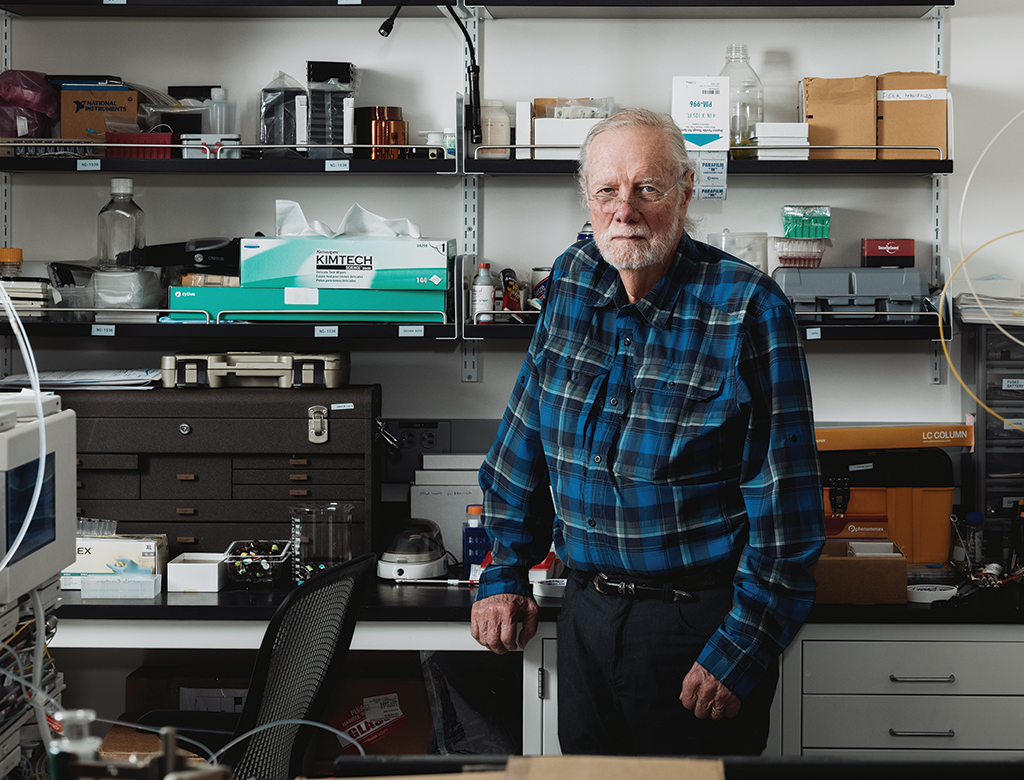
Dafoe is also the son of Stanford Medicine’s Ron Davis, PhD, a pioneer in the field of genetics who has devoted the past decade-plus of his life and career to studying and understanding the disease that has robbed Dafoe of so much.
For people with very severe forms of ME/CFS, life is often curtailed by the same symptoms Dafoe experiences: unexplained pain, exhaustion, and sensitivity to noise and light. Also, as with Dafoe, their symptoms can become so severe that they are unable to talk, read, eat, drink or get out of bed.
“I’ve talked to quite a few doctors who say, ‘We don’t cure chronic diseases.’ And my comment back to them is, ‘Because you think you can’t cure them, you never try.’ ”
Ron Davis, a pioneer in the field of genetics who has devoted the past decade-plus of his life and career to researching severe chronic fatigue syndrome
Davis said his son has seen some improvement in his symptoms recently by taking an off-label medication, but he’s not cured. A photographer who, before his illness, traveled the world for his work, Dafoe now makes self-portraits and short videos that capture the realities of life with ME/CFS and is active on ME/CFS forums and his blog.
Much of ME/CFS treatment is built on trial-and-error solutions for each patient — the Food and Drug Administration has not approved any drugs to treat the disease. The treatments that do exist focus on managing symptoms rather than addressing the root cause of the disease, which is still unknown.
Though at least 3.3 million people live with ME/CFS in the United States, federal funding for researching the disease has been minimal, and many medical professionals still dismiss the illness as psychological or due to other conditions.
Since 2013, when Davis pivoted from researching genetics to studying ME/CFS, his work has largely been supported by private donations that have helped him make strides in cracking the mysteries of the disease. In 2015, he and his colleagues launched a “big data” approach to understanding the disease, deeply profiling several different types of molecular systems in 20 patients with severe ME/CFS who were bed-bound and 10 healthy control volunteers. The resulting dataset, the largest ever generated in ME/CFS, was completed in 2018.

And it uncovered a lot. Maybe too much. “Oh my god, there’s an unbelievable number of things wrong,” Davis said. “Then it’s a matter of trying to take this apart and figure out what could be going on.”
Davis and his colleagues published a study in the journal Healthcare in 2021 describing clinical symptoms of the 20 patients, including the similarity between their symptoms and those of long COVID, and another in the journal Frontiers in Human Neuroscience early in 2025 that investigated the genes and networks that go awry in the disease.
Zeroing in on metabolism
Many of the molecular differences between the people in the study with ME/CFS and the healthy volunteers were related to their metabolism. Davis has developed a theory that infection permanently changes a specific aspect of metabolism in people with ME/CFS, many of whom see their conditions develop after a severe viral infection. In fact, ME/CFS and long COVID — caused by infection with the virus SARS-CoV-2 — have many parallels, and some scientists, Davis included, think the two might be the same disease.
In this hypothesis of the root cause of ME/CFS, immune cells make a certain product of metabolism in response to infection. This metabolite, known as itaconate, ramps up other parts of the immune system’s virus-fighting abilities, but it also shuts down the normal energy production pathway in favor of one that’s less effective, which is part of the reason we feel tired when we have a cold or flu. Normally, this switch is short-lived, but in ME/CFS it could become permanently stuck in the lower energy mode. Several molecules are involved in this process and Davis believes different parts of the process might go wrong in different patients.
Another hypothesis from the big data study centers on the body’s production of nitric oxide, a small molecule with many important roles in biology, including regulating the brain-signaling molecules dopamine and serotonin, levels of which are often out of whack in ME/CFS. Davis and his colleagues have also found mutations in several genes related to the metabolic and nitric oxide pathways in people with ME/CFS.
Finding hope in the research
Although these hypotheses need further testing, Davis is buoyed by the fact that several drugs exist that target the pathways involved. A few patients taking a JAK-STAT inhibitor, a drug that affects the metabolic pathway, have seen a reversal of their symptoms, but it doesn’t work for other people and side effects can be severe, Davis said. Still, the successful cases give him hope that research will find a better way forward.
“I’ve talked to quite a few doctors who say, ‘We don’t cure chronic diseases.’ And my comment back to them is, ‘Because you think you can’t cure them, you never try,’” he said. “With ME/CFS, we’re left in that mode of no, it’s not curable. Well, I’m not quite sure I believe that.” — Contact Rachel Tompa at medmag@stanford.edu